Why Irrigation Farming Is the Future of Agriculture in Ghana
Imagine watching months of hard work wither away because the rains came too late — or not at all. For millions of farmers across Ghana and sub-Saharan Africa, this is not a hypothetical scenario. It is a painful, recurring reality that costs livelihoods, threatens food security, and deepens rural poverty every single year.
But there is a better way forward.
Irrigation farming is rapidly emerging as one of the most powerful tools available to Ghanaian farmers who want to take control of their agricultural outcomes — regardless of the weather. At Gido Agro Ltd, a subsidiary of the GIDO Group Ltd, we have seen firsthand how access to reliable irrigation transforms struggling smallholder farms into thriving, productive enterprises. This guide explores what irrigation farming really means, why it matters so deeply in the African context, and how farmers across Ghana can begin making the shift today.
What Is Irrigation Farming?
Irrigation farming is the practice of artificially supplying water to crops using controlled systems, rather than relying solely on rainfall. It allows farmers to grow food throughout the year, including during Ghana's dry season when traditional rain-fed agriculture is simply not possible.
At its core, irrigation farming is about water management — delivering the right amount of water to the right place at the right time. Done properly, it reduces water waste, increases crop yields, and gives farmers the ability to plan with confidence.
In Ghana, where the agricultural calendar is tightly tied to two main rainy seasons — the major season (March to July in the south) and the minor season (September to November) — irrigation opens up the entire calendar for productive farming.
Types of Irrigation Systems Used in Ghana
Not all irrigation systems are created equal. The best choice for your farm depends on your crop type, land size, water source, and budget. Here is a breakdown of the most commonly used systems in Ghana and across Africa.
1. Drip Irrigation
Drip irrigation is widely regarded as one of the most efficient irrigation methods available. Water is delivered directly to the root zone of plants through a network of tubes, pipes, and emitters. This dramatically reduces water loss through evaporation and runoff.
For vegetable farmers, fruit growers, and those farming high-value crops like tomatoes, peppers, onions, and watermelons, drip irrigation is often the gold standard. It is particularly well-suited to Ghana's Northern Region and other semi-arid zones where water is scarce and expensive to pump.
2. Sprinkler Irrigation
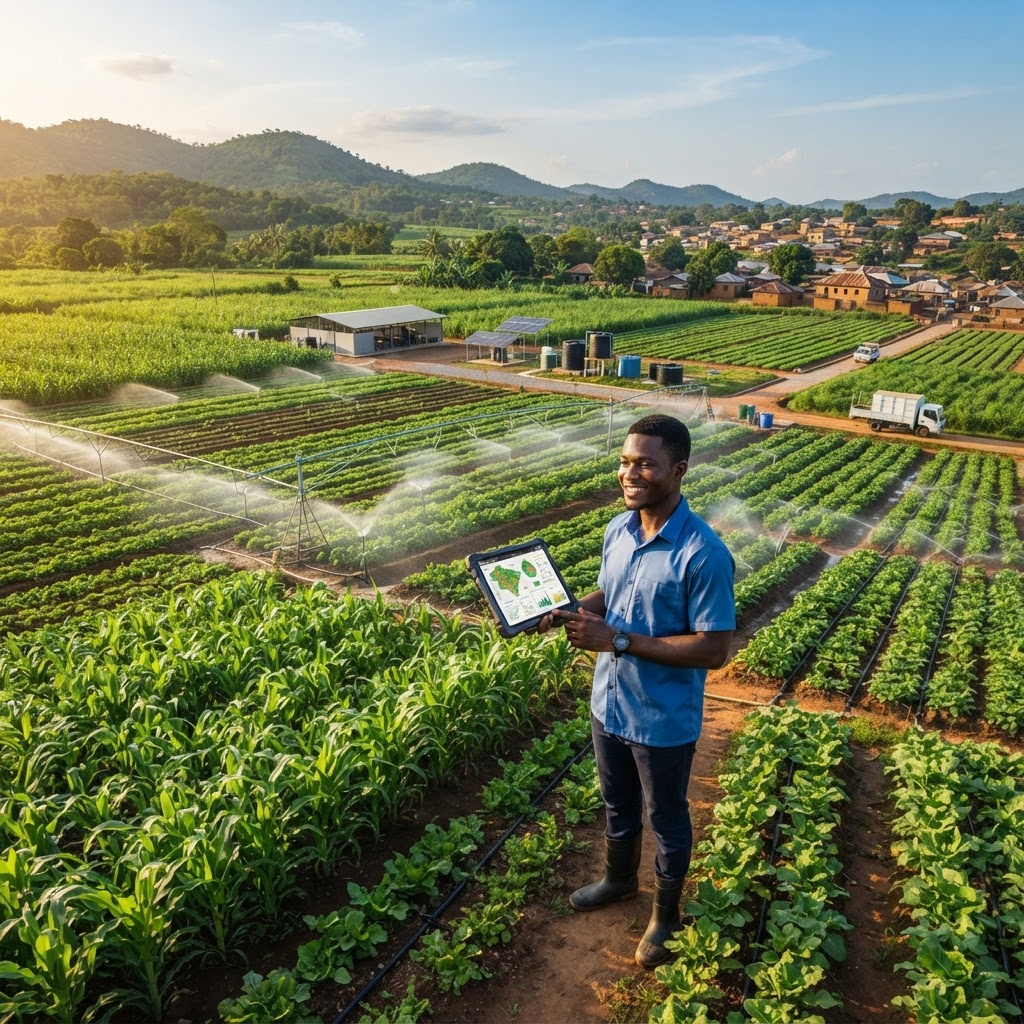
Sprinkler systems mimic rainfall by distributing water through overhead nozzles. They work well for a wide range of crops and are popular on larger farms growing maize, rice, and legumes. While they use more water than drip systems, they are easier to install over large areas and can double as a crop cooling mechanism during intense heat.
3. Surface or Flood Irrigation
This is the oldest and most widely practised form of irrigation across Africa. Water flows along furrows or over fields by gravity. While it requires little equipment, it is the least efficient method — much of the water is lost before it reaches the plant roots. Many smallholder farmers in Ghana still rely on this method, but with proper field levelling and water management, surface irrigation can be significantly improved.
4. Subsurface Irrigation
Subsurface systems deliver water below the soil surface through buried pipes or tubes. They are highly efficient and reduce weed growth, but they come with a higher installation cost and require more technical know-how to maintain. They are gaining traction among commercial farms in Ghana as agricultural technology continues to advance.
The Case for Irrigation Farming in Ghana
Ghana is blessed with substantial water resources — from the Volta River system and Lake Volta to smaller rivers, dams, and boreholes scattered across the country. Yet paradoxically, a huge proportion of Ghanaian farmland remains entirely rain-fed.
According to data from the Ghana Irrigation Development Authority (GIDA), only a fraction of Ghana's total irrigable land is currently under active irrigation. This gap represents both a challenge and an enormous opportunity.
Overcoming the Dry Season Problem
In Ghana's savannah belt — covering much of the Upper East, Upper West, and Northern regions — farmers typically have a single growing window of four to five months. For the remainder of the year, fields lie fallow and idle while families struggle to sustain themselves on income from a single harvest.
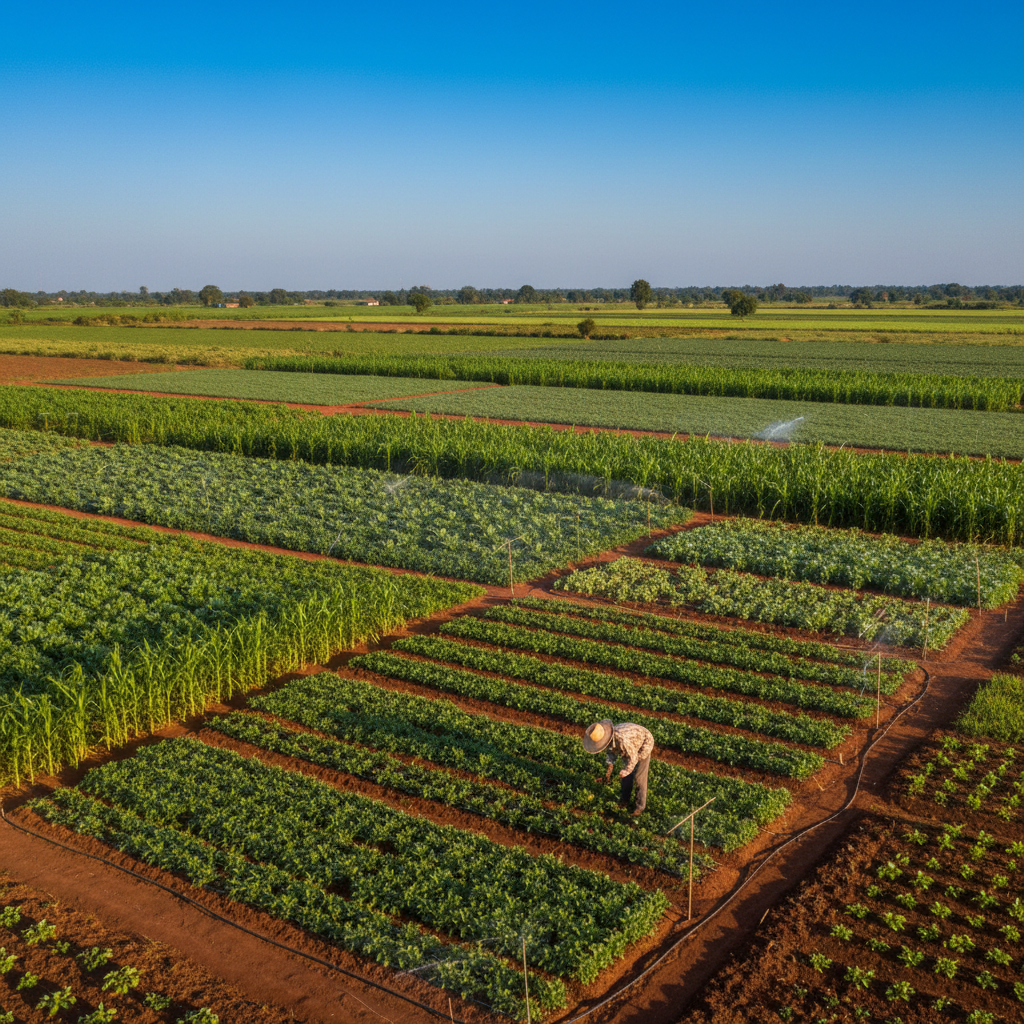
With irrigation, these same farmers can grow two or even three crops per year on the same piece of land. The economic impact of that shift is transformative. A farmer producing one maize harvest a year can, with irrigation, add dry-season tomato or onion production — crops that command premium prices in local and urban markets during the off-season.
Reducing Climate Risk
Climate change is making Ghana's rainfall patterns increasingly unpredictable. Droughts that were once rare events are becoming more frequent. Late rains, early season dry spells, and erratic weather events are pushing farmers who rely purely on rainfall into ever greater vulnerability.
Irrigation farming is not just about productivity — it is about resilience. It gives farmers a buffer against climate shocks that would otherwise wipe out an entire season's work.
Improving Food Security and Incomes
Ghana continues to import significant quantities of vegetables, rice, and other staples that could be produced locally. Much of that import dependence is driven by the inability of local farmers to produce consistently throughout the year.
Expanded irrigation capacity can directly reduce Ghana's food import bill while simultaneously raising farm incomes. Studies across sub-Saharan Africa consistently show that irrigated farmers earn significantly more per hectare than their rain-fed counterparts — often by a factor of two to three times.
Getting Started with Irrigation on Your Farm
If you are a farmer in Ghana considering irrigation for the first time, here is a practical framework to guide your decision-making.
Step 1: Assess Your Water Source
Before anything else, identify your water source. Do you have access to a river, dam, borehole, or pond? Understanding the reliability, volume, and quality of your water supply will determine which irrigation system is feasible for your land.
Step 2: Evaluate Your Crops and Land Size
Different crops have different water needs. Leafy vegetables like lettuce and cabbage have high water demands and do well with drip or sprinkler systems. Cereals like maize are often better suited to surface or sprinkler irrigation on larger plots. Match your system to what you grow and how much land you are farming.
Step 3: Calculate Your Budget and Seek Support
Irrigation infrastructure has an upfront cost, but it is an investment that pays back quickly. In Ghana, several financing options exist — from government agricultural loans through ADB Bank to NGO-supported programs and private agri-finance providers. Gido Agro Ltd works with farmers and farming communities to identify sustainable solutions that fit within realistic budgets.
Step 4: Partner with Experts
Proper installation and maintenance of irrigation systems requires technical expertise. Working with a knowledgeable partner ensures your system is designed efficiently, installed correctly, and maintained well over time. Poor installation wastes money and water — exactly the opposite of what irrigation is meant to achieve.
Gido Agro Ltd's Commitment to Irrigation Farming in Ghana
At Gido Agro Ltd, we understand the realities facing Ghanaian farmers — the uncertainty of rain, the pressure of rising input costs, and the need to feed growing families and communities. Our agricultural operations are grounded in the belief that modern, sustainable farming practices are not luxuries reserved for large commercial farms. They are tools that every farmer deserves access to.
We integrate irrigation planning into our farm support services, working alongside smallholder and commercial farmers across Ghana to design systems that are practical, affordable, and built for long-term productivity. Whether you are growing vegetables, fruits, or staple grains, we are here to help you farm smarter — not just harder.
Irrigation farming is not a magic solution, but paired with quality seeds, good agronomic practices, and proper market linkages, it is one of the most impactful investments a Ghanaian farmer can make.
The Road Ahead: Scaling Irrigation Across Africa
Across the continent, African governments and private sector players are beginning to recognise what farmers have always known — water is the lifeblood of agriculture. Investments in irrigation infrastructure are growing, from large-scale government dam projects to community-level solar-powered pumping schemes.
In Ghana, the government's Planting for Food and Jobs initiative has created new policy space for expanded irrigation support. Regional development programs, including those supported by the African Development Bank, are funding irrigation projects that are already changing lives in the Upper East and Volta regions.
For Ghana to achieve food self-sufficiency and build an agricultural sector that competes on the global stage, irrigation must move from the margins to the mainstream. The potential is there. The water is there. What is needed now is commitment, investment, and the right partnerships.
At Gido Agro Ltd, we are proud to be part of that journey — helping to build a more food-secure, prosperous Ghana, one farm at a time.
Final Thoughts
Irrigation farming is not a distant technology or something reserved for wealthy commercial enterprises. It is a practical, proven, and increasingly accessible solution for farmers across Ghana who are ready to move beyond the limitations of rain-fed agriculture.
Whether you are a smallholder in the Northern Region, a peri-urban vegetable farmer near Accra, or a commercial grower in the Brong-Ahafo region, irrigation can change the trajectory of your farm — and your future.
The rains will come and go. But with the right irrigation system in place, your farm does not have to.